
For a long time, phishing survived because it was good enough. It didn’t need to be perfect. It just needed to catch the distracted, the rushed, or the unlucky. We were trained to look for the “tells.” Bad grammar didn’t matter to the attacker. Broken layouts didn’t matter. Even getting blocked didn’t matter, because the cost of trying again was basically zero. You burned the domain and moved on.
Spiderman changes that equation.
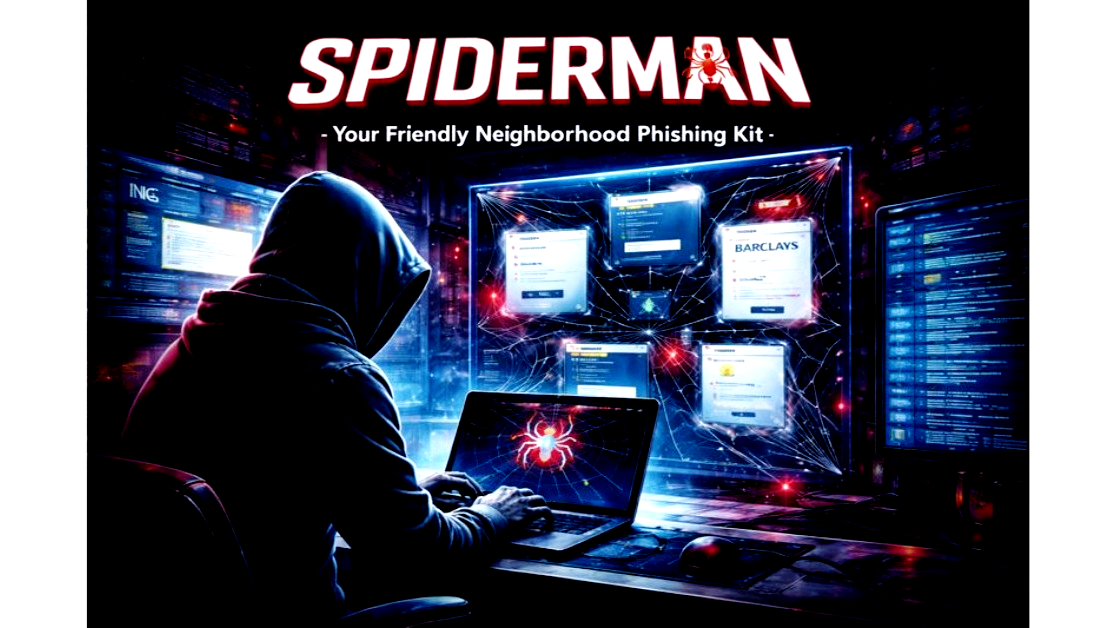
This isn’t another phishing kit dumped on a forum. It isn’t a pile of HTML files or a half-working proxy script that only functions if the operator understands authentication flows. Spiderman is what happens when phishing stops being an attack technique and becomes a professional product—designed, packaged, supported, and optimized for scale. It is the SaaS-ification of cybercrime, and it delivers results with unsettling consistency.
Pixel-Perfect, On Demand
Spiderman allows an operator to generate pixel-perfect clones of real banking and cryptocurrency login portals—not similar-looking, not “good enough,” but indistinguishable to anyone who has actually used the real site before. Deutsche Bank. ING. Barclays. CaixaBank. Ledger. MetaMask. Exodus. Pick one from a menu, click a button, and a live replica appears in seconds. No coding. No tweaking. No guesswork. The page behaves exactly like the real one because, behind the scenes, it’s communicating with the real service.
What makes this dangerous is how literal that menu is.
This isn’t a single fake site spun up for a one-off campaign. Spiderman presents operators with a dropdown list of banks, payment providers, and crypto wallets and generates fully functional clones on demand. Traditional finance and crypto are treated the same way because the objective is the same in both cases: intercept the login, take control of the session, and drain whatever sits behind it. If value is gated by a login, it’s in scope.
Stealing the Session, Not the Password
Spiderman doesn’t depend on tricking users with fake pages. It positions itself between the user and the legitimate service, quietly relaying everything back and forth in real time. It acts as a transparent mirror. Credentials. MFA challenges. Session tokens. The exchange unfolds exactly as expected—just with an extra participant observing and capturing everything.
From the bank’s perspective, authentication succeeds.
From the user’s perspective, nothing feels off.
From the attacker’s perspective, the account is compromised.
That includes two-factor authentication.
This isn’t brute force. It isn’t MFA fatigue. It isn’t exploiting weak implementations. The kit waits for the legitimate challenge. When the bank issues an MFA request—SMS code, app approval, PhotoTAN, whatever that institution uses—Spiderman mirrors it to the victim and relays the response back instantly. What the attacker gains isn’t a password, but something far more useful: a live, authenticated session token.
At that point, there is no follow-up step. The attacker isn’t logging in later. They’re already operating inside the account, under the same trusted session as the victim’s browser.
This is why this attack class has succeeded even in mature security environments. In late 2024, an employee account at Microsoft was compromised through an adversary-in-the-middle phishing attack that captured a live session rather than a password. MFA was enabled. Training was in place. The authentication flow worked exactly as designed—and that’s what made it exploitable. The attacker didn’t defeat security controls. They relied on them.
Weaponized Usability
The technical capability alone would be concerning. What pushes Spiderman over the edge is how easy it is to operate.
The interface looks like any modern SaaS dashboard—clean, intuitive, and data-rich. Operators can watch victims interact with pages in real time. Captured credentials and session data are logged automatically and ready for export.
There’s also built-in chat functionality. If a victim hesitates at a prompt, the operator can message them instantly while posing as bank support, walking them through “verification” steps as access is drained. This isn’t improvisation. It’s a scripted workflow. The operator doesn’t need persuasion skills—just the ability to follow instructions on the screen.
The platform escalates automatically when it detects a cryptocurrency wallet. Seed phrase prompts appear. One successful interaction is enough to empty everything. The loss is immediate and irreversible. This is how individuals lose millions overnight—not because they ignored warnings, but because the page was flawless and the authentication flow was real.
Why It Stays Alive
Spiderman is also designed to avoid attention for as long as possible. Operators can restrict campaigns by country, ISP, or region. Traffic from VPNs, cloud providers, and known security companies never reaches the phishing page. Automated scanners are redirected. Researchers see dead ends.
The result is simple: pages stay live longer, collect more victims, and disappear after the damage is done.
This isn’t a fringe tool. Reporting suggests roughly 750 people already have access to this platform through underground channels. None of them need to understand how it works. The complexity is fully abstracted. That doesn’t create isolated incidents—it creates scale.
The Economics Guarantee This Works
This isn’t “advanced” phishing. It’s optimized phishing, and it builds on techniques that have already proven effective.
Groups like Scattered Spider demonstrated years ago that manipulating legitimate workflows could be more effective than exploiting software flaws. In 2023, MGM Resorts suffered more than $100 million in operational losses after a help desk reset MFA for a convincing caller. Caesars Entertainment was compromised through similar means and reportedly paid $15 million to contain the fallout.
No zero-days.
No malware.
Just access, timing, and confidence.
Spiderman takes that approach and packages it for mass use.
A subscription costs a few hundred dollars a month. A single successful campaign can produce tens or hundreds of thousands from one victim, or millions when multiple sessions are harvested at once. At that scale, risk becomes a calculation, not a deterrent.
The 2025 Brazilian PIX banking heist made that clear. One insider credential, sold for under $1,000, enabled attackers to move nearly $140 million in hours. No encryption was broken. The attackers simply moved faster than the response.
A Failure of Assumptions
This is why phishing-as-a-service has expanded so rapidly. Platforms like EvilProxy, Tycoon 2FA, Rockstar 2FA—and now Spiderman—focus on removing friction. Every barrier eliminated brings in more operators, more campaigns, and more volume. Recruitment follows that logic. These platforms don’t need elite hackers. They onboard operators, including teenagers, because expertise is no longer the limiting factor. Throughput is.
That exposes the gap most defenses still rely on.
User training assumes visible mistakes.
Session proxying removes them.
MFA assumes passwords are the weak point.
Session theft bypasses the question entirely.
Detection assumes phishing pages look wrong.
These pages don’t.
This isn’t a failure of users. It’s a failure of assumptions.
As long as authentication depends on transferable secrets—passwords, codes, cookies—there will be tools built to intercept them. That’s why passkeys matter. Not as a convenience feature, but because they remove the secret altogether. Nothing to steal. Nothing to relay. Nothing to proxy.
Spiderman exists because the old model is still alive. And until that model changes, platforms like this won’t stop appearing.
They’ll keep improving.
This isn’t the future of phishing.
This is what it looks like after it’s finished maturing.