
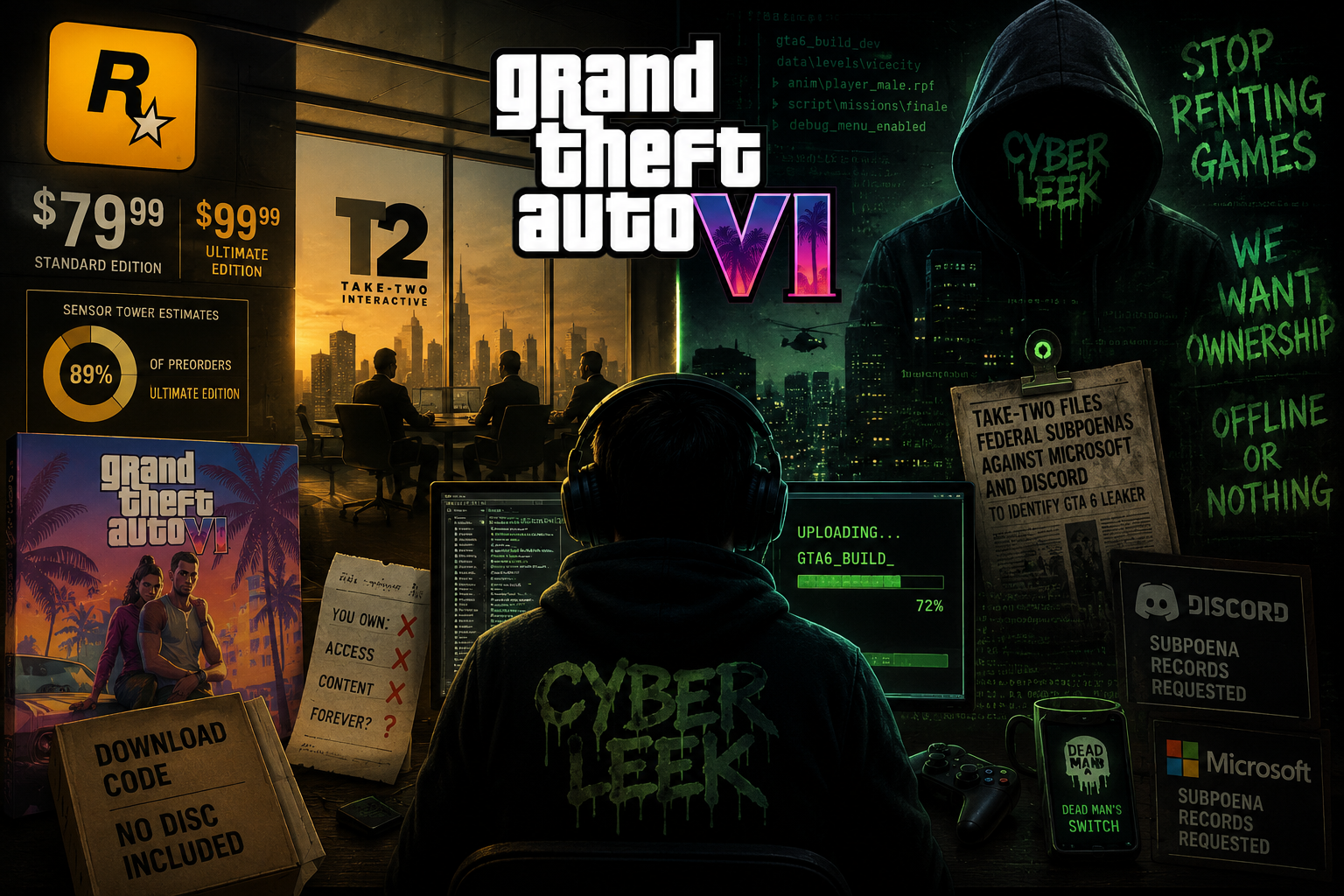
Grand Theft Auto VI costs $79.99.
The Ultimate Edition costs $99.99, and Sensor Tower estimates 89% of preorders went to that one.
For years the ceiling on a big-budget game was $69.99. Ghost of Yotei held it. Zelda held it. Mario Kart World broke it at $80 and took the backlash. Then Rockstar confirmed $79.99 and the ceiling moved for everybody.
That was the point.
Bank of America analyst Omar Dessouky said out loud that GTA VI “should be $80” to help the industry normalize higher prices. Matthew Ball’s State of Video Gaming report documented publishers openly hoping Take-Two would push past $70 so everyone else could follow. Nobody was hiding it. The most anticipated game in twenty years was going to be used as a battering ram against what consumers were willing to pay, and it worked.
MIDiA Research surveyed two thousand US consumers and found 60% would probably buy at $69.99 and 35% would probably buy at $99.99. Their conclusion was that Rockstar makes more money at $70 than at $100.
Which makes eighty dollars look less like optimizing this one game and more like an attempt to move the ceiling for everything that follows it.
So what does eighty dollars actually get you.
A download code in a box. Rockstar isn’t shipping a disc at launch. After the backlash they clarified discs would follow “months” later, with one insider saying December. The physical edition of the biggest game of the decade is cardboard wrapped around a piece of paper.
You pay before anyone reviews it. You pay twenty more for Ultimate Edition content nobody can verify isn’t already sitting in the files you bought. And whatever’s tied to Rockstar’s servers exists exactly as long as Rockstar wants it to.
Eighty dollars for a license, in an economy where wages didn’t move.
Inflation was a passable excuse when games went from $60 to $70. It isn’t one now. In 2013, GTA V cost $60 and a PS3 cost $299. Today the game and a console together run more than double that, Sony raised PS5 prices globally this year, and Circana’s Mat Piscatella expects them to keep climbing.
Somebody was going to do something about it eventually.
How We Got Here
None of this started with GTA VI. It’s the endpoint of about fifteen years moving in one direction.
Preorders survived the death of the thing that justified them. They existed because discs had manufacturing limits and stores got a finite allocation. A digital copy can’t sell out. The reason evaporated and the mechanism stayed, because getting paid before anyone can review the product is worth too much to give up.
Then content started shipping locked. Not downloaded later, shipping on the disc and locked, waiting for a payment to flip a variable. The industry got sued over it, apologized for it, and kept doing it in quieter forms.
Then games started dying. Ubisoft shut down The Crew’s servers and a game people paid full price for stopped existing on their hard drives. That’s the entire reason Stop Killing Games exists, and two years later that movement is in US and EU proceedings arguing you should be allowed to keep what you bought.
Then microtransactions became the actual product. GTA V has shipped over 225 million copies and GTA Online reportedly still pulls in more than a million dollars a day. The purchase price is a cover charge now.
And now the disc is going away.
On July 1 of this year, Sony announced on the PlayStation Blog that physical disc production for new PlayStation games ends in January 2028. The stated reason was consumer preference. The same day, Sony announced the PS3 and PS Vita stores would close in stages through July 2027, with games people already bought remaining downloadable “for the foreseeable future.”
That’s the phrase. Not permanently. For the foreseeable future.
Sony tried closing those stores in 2021, hit a wall of preservation backlash, and reversed. Five years later they did it again and nobody could stop them.
Every one of those moves made sense on a spreadsheet. Together they add up to a simple proposition: you don’t own games anymore, you rent access, the rent went up, and the landlord decides when the building comes down.
Somebody was going to test that eventually.
Then Somebody Did
On August 18, an account called CyberLeek started posting gameplay from a build nobody outside Rockstar was supposed to have.
Rockstar has said nothing publicly.
Take-Two was in federal court in two days.
That gap is the story.
He’s Holding the Controller
The first clips could have been anything. Internal recordings. QA capture. Something a contractor walked off with years ago.
Then Jason walked up to a wall, fired an automatic weapon, and spelled out LEEK in bullet holes.
You don’t do that with stolen video files.
Somebody was playing the game.
That clip changed what kind of incident this is. Leaked footage is embarrassing. Interactive access to a development build means whoever has it can go anywhere in that build and record whatever he wants. Missions nobody’s seen. Story beats. Environments. Debug menus. The ending.
And he’s rationing it.
Driving clips. A gas station holdup. Two minutes of a hypercar. A basketball minigame. A strip club tease. A carjacking showing mechanics Rockstar hadn’t announced. Each one enough for a news cycle. None of them enough to matter alone.
He isn’t leaking the game. He’s metering it, and he decides the rate. The danger to Take-Two was never the clips that already went out. It’s the ones he’s still sitting on.
The Thing Take-Two Can’t Rule Out
If somebody has a working build of GTA VI, the worst case isn’t more clips.
It’s the game. Free. Before November 19.
That possibility has been sitting under this whole story since the LEEK video, and the loudest version of it turned out to be fake, so the details matter here.
On August 22, reports circulated that CyberLeek had a dead man’s switch: copies of the build distributed to multiple locations worldwide, set to release automatically unless he manually cancelled it every 24 hours. Insider Gaming ran it. Wolf’s Gaming Blog ran it. Anonymous amplified it on X.
Insider Gaming retracted it the next day. The report came from an image that had been fabricated and circulated by somebody imitating CyberLeek, not from anything he posted. They pulled it themselves and said so publicly, which cost them traffic on the biggest gaming story of the year.
The retraction is more interesting than the retracted story. It says there’s no confirmation either way that CyberLeek has a full build, and no reason to assume a group operating at this level doesn’t have a mechanism that does exactly what the fake image described.
Nobody outside CyberLeek knows what he has. Leak tracker NateTheHate has described the footage as roughly a year old, which could mean an old test build with a fraction of the game in it, or could mean a year-old build of a game that was already largely finished. Nobody knows whether it’s playable start to finish. Nobody knows how many copies exist or where.
Rockstar and Take-Two have said nothing about any of it. Not to confirm, not to deny. That silence isn’t evidence the claim is true. Companies have real reasons to stay quiet even about things they know are false, starting with the fact that answering an attacker validates the pressure campaign and commits you to answering the next one.
And this is why none of that uncertainty helps Take-Two. The threat doesn’t have to be real to work.
Take-Two has to plan around the worst case whether or not the worst case exists. That’s not a choice, that’s risk management on a product carrying the largest revenue expectation in the history of the medium. And the fabricated image proved how well that dynamic functions. Somebody who wasn’t even CyberLeek made a screenshot, and it moved through two outlets and a hacktivist account and became a story that Rockstar still hasn’t addressed.
Uncertainty is the weapon. He doesn’t have to press the button. He just has to make sure nobody can prove there isn’t one.
What Rockstar Isn’t Saying
Bloomberg’s Jason Schreier reported that as of August 21, Rockstar still didn’t know who CyberLeek is or how he got in. All hands on deck internally. This is a company that ended remote work after the 2022 breach specifically so this couldn’t happen again.
Most coverage read that as Rockstar having nothing.
That’s not what it means.
Finding out something happened and reconstructing what happened are two different jobs, and one is much harder than the other.
The first sign is never a story. It’s an artifact that doesn’t fit. Data leaving in a volume that doesn’t normally leave. An account touching a build repository it has no business touching. A session at 3 a.m. from someone who’s never worked past six. A devkit checked out with no ticket behind it. A transfer to a destination that appears nowhere else in six months of logs.
None of that tells you who.
Some of it doesn’t tell you how.
But it tells you the thing is real, and real is enough to move on.
Reconstructing the full chain is where it stalls. That takes correlation across systems with different retention windows, and across companies that don’t answer to Rockstar’s security team. Microsoft’s records. Discord’s telemetry. Whatever an ISP kept. Rockstar can see its own perimeter and nothing past it.
That’s when you stop investigating and start subpoenaing.
So “we don’t know how he got in” and “we know exactly how bad this could get” aren’t contradictions. That’s what day five looks like from inside an active incident. The silence tells you the first part. The filings tell you the second.
That’s inference. Rockstar hasn’t disclosed anything about what they found. I’m describing how incident response works, not claiming to know what’s in their logs.
Read the Filing
On August 20, Take-Two petitioned the Southern District of New York for DMCA subpoenas against Microsoft and Discord. Granted by Friday. Compliance due September 4.
Section 512(h) is the mechanism, and it’s an expedited identification tool rather than a conventional lawsuit. Take-Two doesn’t have to litigate a full copyright case against a named defendant first. It submits the statutory materials and a sworn declaration stating the purpose is obtaining information sufficient to identify the alleged infringer.
It’s fast. That’s why they used it.
From Microsoft they want account IDs, registration emails, registration and login IPs, phone numbers, linked accounts, device identifiers including Windows MachineGuid, OneDrive content mentioning GTA or Rockstar or CyberLeek, and Microsoft’s own internal investigative file on the persona.
From Discord they want identifying information for all user accounts that were members communicating in a list of named servers, going back to June 1. Emails. IPs. Phone numbers. Device identifiers. Linked Xbox and Google accounts.
Not the suspect’s account. Everyone who talked in those rooms for three months.
Microsoft isn’t fighting it. Xbox CTO Scott Van Vliet confirmed publicly they’re working with Take-Two and Rockstar.
Look at that request as evidence instead of as a legal document.
Nobody asks for every member of a Discord server plus a platform’s internal investigation file when they know who they’re after. That’s not narrowing. That’s dragging a net and hoping something’s in it.
The scope isn’t confidence. It’s what an investigation looks like when nobody has a name yet.
And if you’re worried about a full build going public, finding the person isn’t only about punishing him afterward. It’s how you get to the machines the files are sitting on while they’re still sitting there.
And it lands on people who had nothing to do with this. The list swept in the editors’ server belonging to GTA V streamer Matthew “DarkViperAU” Judge, who says he knows nothing, the server they named isn’t even his, and his best guess is CyberLeek lurked in his Discord after he spent weeks on stream saying the leaker can’t drive.
Everyone else in those servers is in the same spot. They joined a chat room. Now their phone number, IP history, and linked Google account are part of a copyright action.
The Part We Can’t See
This is the part that doesn’t show up in any coverage.
CyberLeek is releasing enough to keep the story alive. That isn’t necessarily everything he has.
Pressure operations don’t generally work by dumping everything at once. Public material proves capability. Whatever stays private proves scope. The second something goes public it stops being leverage.
So look at the response instead of the clips.
Take-Two gets fake leak claims constantly. Fabricated screenshots, people claiming access they don’t have, extortion attempts from nobody. At that scale it’s background noise, and almost none of it produces a federal filing.
This produced one in two days.
Two days, three months from launch, while the company refuses to say anything publicly.
Something set that bar, and the driving footage is a thin explanation for it.
There are two ways that happens. Either CyberLeek showed them something the public hasn’t seen, or Rockstar found something in its own systems that the public hasn’t seen. Both are guesses. What’s observable is only that the response is out of proportion to the evidence the rest of us have, and that gap usually means somebody is working from more than we are.
Why the Demands Land
CyberLeek published his terms as the CYBERLEEK Edict. Three commandments, plus a promise to go after any publisher that breaks one.
No digital preorders. Nobody pays through a digital storefront before release and independent review. His argument is the one above: preorders existed because discs had manufacturing limits, a digital copy can’t sell out, and publishers kept the mechanism after deleting the only reason it benefited a customer. If publishers want money before launch, press discs and put them on shelves.
No fake single-player DLC. No selling access to single-player content that already shipped in the files. He gets specific. No unlock keys, no 1MB placeholder files, no flipping a variable from locked to unlocked for content that’s already in the download. If someone paid seventy-plus dollars, they bought the data. All of it.
Preserve single-player content. Every game with single-player content ships an offline fallback, and when the servers die the publisher pushes a final patch unlocking everything for local play, permanently.
Compare those three against the fifteen years above.
He didn’t write a manifesto. He wrote an itemized invoice.
It got traction for the same reason 2022 didn’t. Arion Kurtaj was a teenager who phished an employee and dumped ninety videos with no argument attached, and nobody defended him. This time the demands describe things that are actually happening to actual people, and a lot of those people are quietly enjoying this.
Take-Two can’t answer any of it, and the reason has nothing to do with whether the demands are reasonable. Answering means admitting the business model is the problem. Preorders are already sold. Offline fallback is an architecture decision made years ago. The hundred-dollar tier is where the margin lives. And Sony is killing discs in eighteen months regardless of what Rockstar does.
So they don’t answer. They subpoena.
The Coin
The financing is the weakest part of what he’s doing, and it’s the part that will be used to discredit everything else.
The Edict says the money funds infrastructure and the security needed to withstand corporate counterattacks. That’s a coherent thing to need. Distributed hosting, mirrors, operational security, and legal exposure all cost money, and he’s up against a company with effectively unlimited resources.
But the sequence is a problem. Bitquery ran the on-chain records and verified the figures August 21. The domain went up August 14. The $CYBERLEEK token first traded August 15. The footage broke August 18, with QR codes for the site and the coin burned into the videos.
The financing was in place before the campaign started. Read generously, that’s planning. Read plainly, the leak had a monetization layer from day one.
And the donation polls make it harder to read generously. The site let token holders vote on which clip dropped next. Pay in, pick the next leak.
One detail complicates the simple grift story. Bitquery found the five wallets that pulled the most out of the pump, about $158,000 between them, all bought inside the same six-minute window, and none trace back to whoever deployed the token. They were bots. Automated traders that buy anything moving. Even the wallets that looked like they got free supply turned out to be arbitrage bots. Whatever he built, the biggest payout went to trading algorithms that never read the manifesto.
Stop Killing Games condemned him directly and told people not to send him money. They’ve spent two years building a legitimate case in courtrooms, and now the loudest person making their argument is running a Solana token. Every publisher on earth gets to point at CyberLeek from here on and treat the entire preservation movement as a grift.
The real damage here never landed on Rockstar.
Two Clocks
September 4 is the subpoena deadline. November 19 is release day.
Rockstar hasn’t blinked publicly. Preorders broke records, Bloomberg reports the leaks probably won’t dent a launch at that scale, and the Netflix reveal stayed on August 27 with the release still on November 19. The 2022 breach put ninety development videos online and the game still came.
But the exposure was never more clips.
Take-Two priced this at eighty dollars betting that wanting it badly enough overrides what it costs. MIDiA measured that bet against price and it held. It has not been tested against the game being available for free three weeks before launch.
And the Edict closed off the exit. No private negotiations. No quiet settlements. The public sees it, or the leaks don’t stop. Take-Two couldn’t settle quietly even if it wanted to, because capitulating in public confirms the material is real and puts on the record that leaking works. Every actor after this one opens at a higher number.
So it’s absorb whatever comes and try to get to him before he decides to escalate, or before somebody makes the decision for him.
That’s what September 4 is. Not a formality. It’s the day Take-Two finds out whether the part of the chain it can’t see contains one correlation worth having.
What This Actually Is
An attacker has to get operational security right everywhere. Rockstar’s logs, Microsoft’s account records, Discord’s telemetry, an ISP’s retention policy, some wallet that touched a regulated exchange two years ago. Investigators need one of those to line up. That asymmetry is why patient investigations usually win, and it’s why I’d bet on Take-Two eventually.
But this was never really a story about attribution.
An industry spent fifteen years teaching people they don’t own what they pay for. It kept preorders after deleting the reason for them. It sold back content that shipped in the box. It turned off games people bought. It made microtransactions the actual product and the purchase price a cover charge. It raised the ceiling to eighty dollars in an economy where wages didn’t move, said out loud that the increase was meant to give every other publisher cover, and announced the disc is dead in 2028.
Then it acted shocked when somebody decided the rules didn’t apply to him either.
CyberLeek isn’t a hero. He attached a token to a consumer rights argument, took money from people who believed him, and handed every publisher a reason to dismiss the movement he claimed to be fighting for.
But he didn’t invent the grievance. He found it lying there fully formed, with millions of people already furious about it, and picked it up because it was the most effective leverage available to him.
None of that is something Take-Two can subpoena.
They’ll spend whatever it takes to find out who did this. They won’t spend a dollar asking why it landed.
Sources: Pricing confirmed by Rockstar at $79.99 standard and $99.99 Ultimate. Preorder tier share per Sensor Tower, unconfirmed by Take-Two. Analyst pricing commentary per Bank of America’s Omar Dessouky and Matthew Ball’s State of Video Gaming report. Consumer survey per MIDiA Research. Disc timing per Rockstar’s clarification following launch backlash. Sony’s disc production announcement and PS3/Vita store closures per the PlayStation Blog, July 1, 2026. Dead man’s switch reports published August 22 by Insider Gaming and Wolf’s Gaming Blog; Insider Gaming retracted its report the following day, identifying the source image as fabricated by a third party imitating CyberLeek. Rockstar and Take-Two have made no public statement on the claim. Build age per leak tracker NateTheHate. Investigation status per Bloomberg’s Jason Schreier. Subpoena scope per petitions filed August 20 in the Southern District of New York, granted with a September 4 deadline. On-chain timeline and wallet analysis per Bitquery, figures verified August 21. Edict text from CyberLeek’s published manifesto. A second group claiming to have phished Rockstar India personnel remains unverified and is not treated as established here, and neither is CyberLeek’s claimed connection to the 2022 breach. This is an active incident.
Leave a Reply