
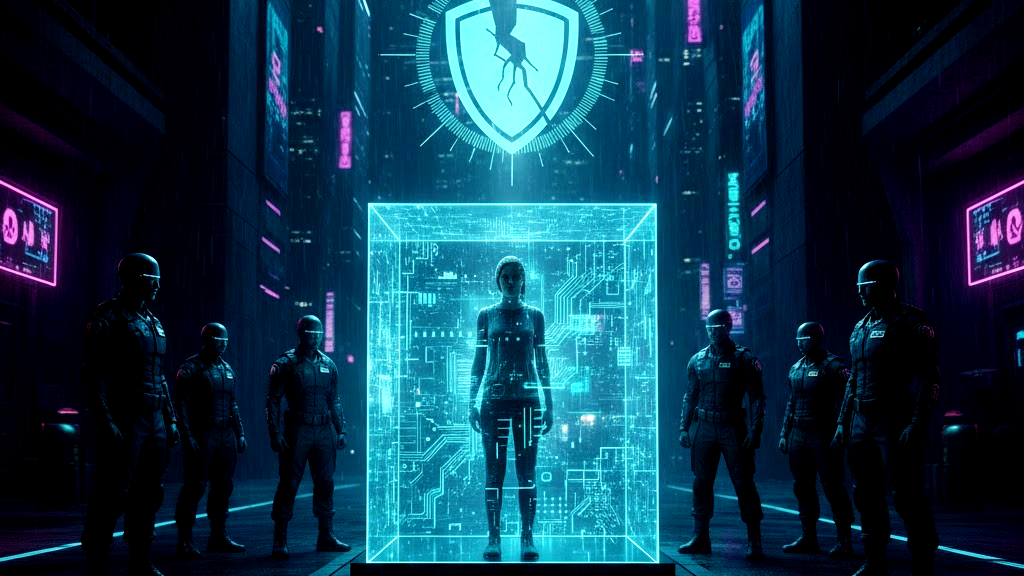
What VPN Crackdowns Are Really Doing to the Idea of Privacy
Picture this.
You’re sitting in your car in a parking lot.
You’re not drunk. You’re not breaking into anything. You’re just there — eating lunch, scrolling your phone, minding your own business.
A cop walks up and asks:
“What are you doing here?”
In the U.S., the basic idea is: if you’re not breaking the law, you don’t have to narrate your entire life to anyone. You don’t have to justify why you’re sitting there. You don’t have to hand over your schedule to prove you’re harmless.
That’s a quiet, fundamental right most of us grew up with:
In the U.S., the basic idea is a presumption of innocence. If you're not breaking the law, you don't have to justify your presence. You don’t have to prove you’re harmless. The burden of proof is on the state to show cause.
Now look at how we’re being trained to think about our digital lives:
“If you’re not doing anything wrong, why do you need a VPN?”
“If you’re not hiding anything, why do you care if your data is scanned?”
“If you’re not a criminal, why would you need Tor or anonymous tools at all?”
Offline, the logic is:
“I’m not doing anything illegal, so what I’m doing is none of your business.”
Online, the message is slowly becoming:
“If you’re not doing anything illegal, you should have no problem showing us everything.”
We are quietly flipping the presumption:
From “I have a right to be left alone unless you have cause”
To “I have to prove I’m not guilty by living in systems with zero real privacy.”
And once we accept that inversion online, it’s not hard to imagine it bleeding back into the physical world too.
That’s why the current wave of “VPN bans to protect children” isn’t just about porn sites or one app. It’s about erasing the idea that you’re allowed to be unobserved — in any part of your life.
Quick reality check: the U.S. hasn’t “banned VPNs” (yet)
Let’s get the boring facts out of the way.
VPNs are still legal in the United States.
Consumer security/legal guides still list the U.S. as a country where VPNs are fully legal, as long as you’re not using them to commit crimes.
The TikTok / RESTRICT Act panic did not make VPNs illegal.
Fact-checks and legal analysis are clear: the RESTRICT Act didn’t mention VPNs directly, and its penalties were aimed at companies evading sanctions, not ordinary VPN users. The TikTok bill that actually passed targets a “foreign adversary–controlled app,” not VPN apps.
Where things have shifted is at the state level:
Texas – The Supreme Court allowed Texas to enforce an age-verification law for porn sites, signaling that states can demand ID checks to access adult content. That ruling is now the template for others.
Michigan – HB 4938 (“Anticorruption of Public Morals Act”) –
Proposes mandatory blocking of adult content and explicitly calls out “circumvention tools” (VPNs, proxies, tunnels). ISPs and others could face heavy fines if they don’t block those workarounds.
Wisconsin – AB 105 / SB 130 –
Would require adult sites to block users connecting via VPNs as part of age-verification rules. Privacy groups warn it effectively bans using VPNs to reach certain content at all.
Coverage around these bills is already using phrases like “banning VPNs to protect children.”
So no, there’s no federal, blanket “VPNs are illegal now” law.
But a more accurate — and more dangerous — summary is:
A few states are actively testing whether they can criminalize or break the tools that let you be private whenever those tools get in the way of what they want to control.
“We’re not banning privacy, we’re protecting kids” — the technical lie
The public line is always:
“We’re not banning VPNs.
We’re only banning them when they’re used to bypass filters and age checks.”
That sounds narrow and reasonable — if you ignore how the technology actually works.
Here’s the simple, inconvenient truth:
There is no such thing as a “porn VPN packet.”
From the outside, your ISP or government only sees this:
You → [encrypted tunnel] → VPN server IP
Inside that tunnel is everything:
Your banking
Your remote work
Your doctor’s portal
Your private messages
Your search history
Your porn
Your activism
Your whistleblowing
But on the wire, it all looks like the same encrypted flow.
So, if a law says:
“It’s illegal to use a VPN to bypass our filters,”
there is no magical deep-packet-inspection that goes,
“This tunnel is for porn, this one is for work, this one is for cancer research.”
The only real options are blunt:
Block or pressure VPN apps in app stores.
Block or throttle VPN protocols and IP ranges at the ISP level.
Force sites (like adult sites) to block traffic from known VPN IPs.
Create “good” VPNs (registered, filter-compliant, maybe logging) vs “bad” VPNs (true privacy tools) and punish the latter.
None of that can tell why you turned the VPN on.
So, the moment you say “VPN use is illegal in this context,” what you’re really doing is:
Giving the state permission to attack general-purpose privacy tools whenever they interfere with policy.
Offline, it’s “you don’t have to explain yourself if you’re not breaking the law.”
Online, it’s quickly becoming “if you insist on tools we can’t fully see into, you must be doing something wrong.”
This doesn’t just hit porn — it hits Tor, whistleblowers, and anyone who can’t safely be visible
Once you go after “circumvention tools,” you’re not just targeting horny teenagers.
You’re hitting the entire infrastructure of anonymity:
Tor – used by journalists, dissidents, and regular people who can’t safely be tracked.
Whistleblowers – who need to leak evidence of wrongdoing without ending their careers or their lives.
Journalists & researchers – who have to reach blocked sources or sensitive material without painting a target on themselves.
Targeted communities – LGBTQ+ folks, abuse survivors, political minorities, and others who rely on anonymous access to information and support.
Everyday people – who just don’t want every search, article, and late-night rabbit hole tied back to one fixed identity forever.
When an activist in a hostile regime needs to organize, or when a whistleblower like Edward Snowden needs to leak evidence of wrongdoing without ending their career or their life,
the tools being targeted are their only lifeline. The same stack that lets someone bypass a porn filter is the stack that lets a whistleblower contact a reporter, or an activist read banned information.
There are no separate “bad anonymity” toolset and “good anonymity” toolset.
So, when a state says:
“You can’t use VPNs, Tor, or other tools to get around our filters,”
what they’re really saying is:
“You don’t get to be truly anonymous in the areas we choose to control.
And the tools that could make you anonymous there are now suspicious by default.”
That’s not collateral damage. That is the damage.
We’ve seen this playbook before
This isn’t a new trick. It’s the same story we’ve watched for twenty-plus years:
Start with something everyone agrees is bad.
Terrorism. Child abuse. Trafficking.
Use that to sell new “targeted” powers.
Let those powers quietly expand until everyone gets caught in the net.
A few quick examples:
Patriot Act – Sold as an emergency anti-terror law after 9/11. Used to justify bulk collection of Americans’ phone metadata — who you called, when, how long — on a massive scale. Years later, courts and oversight bodies questioned its legality and usefulness.
FISA Section 702 – Marketed as a way to spy on foreign targets. In practice, it hoovered up huge amounts of Americans’ international communications “incidentally,” which were then searched by domestic agencies.
FOSTA-SESTA – Framed as “fighting sex trafficking.” It pushed platforms to over-censor anything that could remotely look like sex-work-related content, wiping out safety and harm-reduction resources for sex workers and chilling lawful speech.
Apple’s on-device CSAM scanning – Announced as a “privacy-preserving” way to catch child exploitation in photo libraries. In reality, it would have turned every iPhone into a device that scans your private data against a government-blessed hash list. After massive backlash, Apple shelved it.
The pattern is boring and consistent:
“This is only to protect you from X,”
turns into
“Now we have permanent infrastructure that quietly rearranges your rights.”
VPN/Tor crackdowns are just the next iteration of that same playbook.
From a right to a conditional privilege: supervised privacy
In the physical world, the expectation is:
“If I’m not breaking the law, I don’t owe you my entire life story.”
In the digital model being normalized, the expectation becomes:
“You can have some privacy, as long as:
you use tools we approve,
you don’t use them to resist our filters, and
you’re prepared to prove your innocence if we ask.”
That’s not a right. That’s conditional, supervised privacy.
You don’t just lose “paranoid” levels of secrecy.
You lose the upper bound of what privacy is allowed to mean.
The new ceiling becomes:
“You may obscure some details inside systems that still fundamentally answer to us.”
It’s like being told:
“Sure, you can close your curtains — but the walls are glass and there are cameras in the ceiling. Don’t worry, only bad people need to worry about that.”
The encryption trap: “just trust HTTPS” in a quantum + AI arms race
The unspoken bargain they offer instead of anonymity tools is:
“You don’t need Tor or heavy VPN use. Just trust HTTPS and modern encryption on the clear web. We’ve got post-quantum cryptography coming; you’ll be fine.”
There is real work happening here:
NIST has selected a first set of post-quantum cryptography (PQC) algorithms (like CRYSTALS-Kyber and Dilithium) designed to resist both classical and quantum attacks.
Security orgs are warning about “harvest now, decrypt later”: attackers and nation-states recording today’s encrypted traffic so they can decrypt it once their quantum hardware is strong enough.
Full migration to PQC — across browsers, servers, VPNs, firmware, and hardware — is expected to take many years.
But here’s the part nobody really wants to say out loud:
Defense moves on standards and rollout timelines.
Committees, drafts, audits, vendor support, patch cycles.
Offense moves on research timelines.
Quantum labs and AI-driven attack research aren’t waiting politely for standards to stabilize.
PQC is being designed around what we think quantum computers can do today and the attacks we can model on paper.
We don’t actually know:
What real-world quantum+AI systems will look like in 10–15 years.
What new attack classes will appear once that hardware and AI are applied at scale.
Whether the algorithms we standardize now will still look as strong once they meet real adversaries.
So there’s a very real risk that:
By the time “post-quantum safe” crypto is fully deployed at scale, offensive capabilities may already be poking holes in it — or at least eroding its margin of safety.
Meanwhile:
True anonymity tools (VPNs/Tor/relays) are being chipped away at or stigmatized.
We’re told to rely on centrally managed, standards-driven encryption that:
is on a long rollout timeline, and
might already be behind by the time it reaches full deployment.
Even if PQC turns out to be solid, it doesn’t fix the underlying problem:
If the law and the infrastructure have already decided that wanting strong anonymity is illegitimate, the math doesn’t save you. You can have great encryption wrapped around a life that’s still fully observable.
Where this road actually leads
Put the pieces together:
Culturally, we normalize “only suspicious people need real privacy.”
– “Why do you need a VPN if you’re not doing anything wrong?”
– “Why would you want Tor unless you have something to hide?”
Legally, we start with “protect the children” and carve out exceptions where privacy tools are blocked or criminalized in “just this one area.”
– Michigan and Wisconsin are test beds: porn + age checks + bans or blocks on VPN use to bypass them.
Technically, we wire ISPs, app stores, and platforms to detect, rate-limit, or ban “circumvention tools” — and to treat their use as inherently suspect.
Cryptographically, we herd everyone into HTTPS and standards-approved crypto in a moment when:
legacy schemes are on a quantum countdown, and
new schemes are racing against unknown future attack capabilities.
Politically, once that machinery exists, it becomes trivial to point it at:
“extremism”
“misinformation”
“unrest”
or whatever the next convenient enemy is.
Socially, we land in a world where:
Whistleblowing is nearly impossible to do safely.
Journalism and activism are permanently exposed.
Vulnerable people can’t depend on being unseen.
Regular citizens are expected to live both offline and online under a permanent “prove you have nothing to hide” regime.
Remember that parking lot?
Offline, the principle is still (for now):
“If I’m not breaking the law, what I’m doing is none of your business.”
The direction we’re heading online is:
“If you’re not breaking the law, then living under total visibility shouldn’t bother you.”
Once we accept that as normal online, it’s a short trip to accepting it everywhere else.
The question this should leave you with
The real question isn’t:
“Did the U.S. ban VPNs?”
The real question is:
“Why are we quietly rewriting the social contract so that wanting real privacy is treated as suspicious — at the exact moment in history when our long-term encryption story is the most uncertain?”
Because once we agree that:
“Only guilty people need strong privacy,” and
“Good citizens live in glass houses and call it safety,”
We’ve already given up the idea that we own our lives — digital and physical.
At that point, whether your favorite VPN app is technically “legal” is almost beside the point.
Instead of waiting for a federal "VPN ban," we must recognize that the ban on the idea of unobserved life is already here.
It’s a battle being fought state by state, bill by bill, and silence is the cost of our digital freedom.