
Stop reading the vendor hype. This is what defenders should actually prepare for next year.
Every year-end, the industry fills your feed with vague, recycled warnings. They use fear to sell tools. I’m not doing that.
These predictions are not based on buzzwords; they are based on the cold, hard data of what works for attackers today. The truth is, the fundamental concepts we used to rely on (the perimeter, human detection, stable workforces) are actively collapsing.
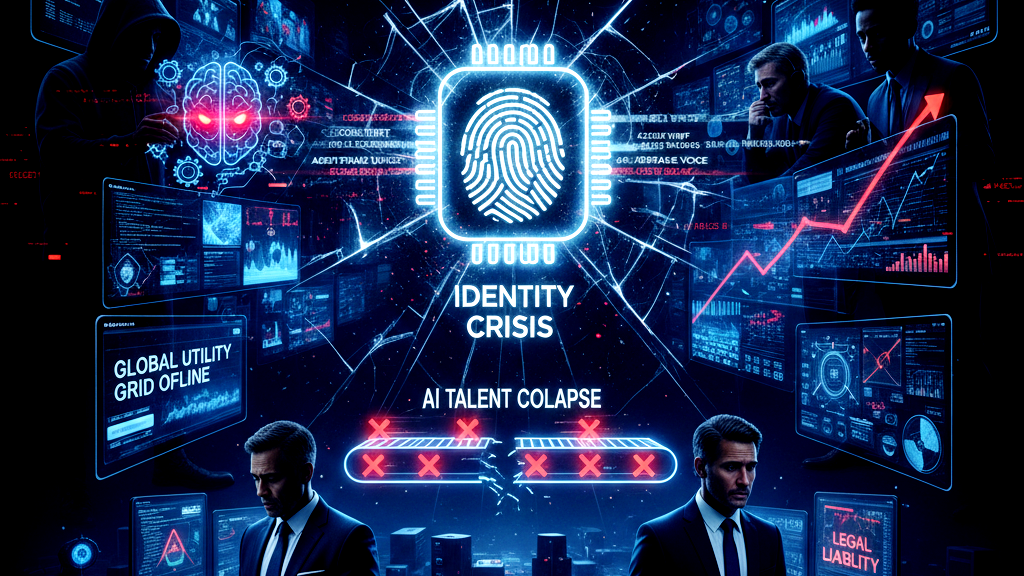
The next twelve months will be defined by Identity as the primary weapon, AI as the speed multiplier, and the high cost of corporate delusion.
Here are the 10 hard truths coming in 2026.
Ransomware Sheds Encryption for Pure Extortion The loud, smash-and-encrypt style of ransomware is over, consolidating instead into silent, multi-stage data-theft and extortion campaigns. This shift is happening because modern backups have killed the leverage of pure system encryption. Attackers know that stealing customer data, contracts, or IP provides infinite, perpetual leverage through regulatory risk, reputation damage, and public leaks, and quiet data exfiltration is much harder to spot than mass file scrambling.
The Breach Vector is Stolen Human Identity The overwhelming majority of high-impact breaches will start with the compromise of a valid human account, token, or session. Organizational trust has shifted completely to the identity layer (SSO, VPN-less access), making the identity provider the main target. Attackers are not exploiting firewalls; they are focused on bypassing MFA through sophisticated methods like cookie theft, session hijacking, and social engineering against helpdesks.
The Next Target: Compromising Machine and AI Identity Attackers will pivot from stealing human credentials to exploiting the identity of autonomous AI agents, service principals, and non-human entities. As automation scales, every script and LLM-driven agent requires broad system access. These non-human identities are often poorly monitored or easily misconfigured. A compromised autonomous agent can act as a high-speed insider threat, capable of massive damage in seconds.
Social Engineering Becomes Indistinguishable from Real Life AI-assisted social engineering will achieve near-perfect realism, making the human element the most critical, unfixable vulnerability. This is because LLMs eliminate all traditional “red flags” (typos, bad grammar) by generating contextually perfect, native-sounding messages. Furthermore, the ease of deepfake voice cloning allows cheap, high-volume vishing campaigns that impersonate executives with alarming realism.
AI Misconfiguration Becomes the Top Internal Outage Risk We will see a sharp rise in critical outages and data exposure caused not by attackers, but by AI-driven automation gone wrong. Companies are rushing to use LLMs to generate complex configuration files (IAM policies, firewall rules) without understanding the model’s limitations. The models lack the context of the legacy environment, and automation executes this flawed code instantly and at scale.
Critical Infrastructure: The Target that Stops the World Cyberattacks against Operational Technology (OT) and Critical Infrastructure (CI) will move past data theft and become primarily disruptive, designed to exert geopolitical pressure. The convergence of IT and OT exposes legacy systems that were never designed for the internet. Compared to kinetic action, cyberattacks are a low-cost, high-impact tool for state-sponsored actors to create immediate, widespread public and political chaos.
The Supply Chain Becomes the Default Entry An overwhelming percentage of breaches at mid-to-large companies will trace back to a compromise at a smaller, less-protected vendor, MSP, or software component. Larger enterprises have raised their security bar, forcing attackers down the chain of trust. Managed Service Providers (MSPs) and smaller niche software vendors are ideal targets: they offer high-value, privileged access to dozens of client networks with minimal security investment.
Cyber Insurance: The Policy Exclusions Will Grow Cyber insurance will solidify its role as a mandatory security auditor, but the true financial danger will be the drastic expansion of policy exclusions. Insurers, facing high payouts, will tighten contract language to exclude coverage for failures related to unpatched critical systems, non-compliance with specific IAM requirements, or poor AI governance. This will lead to major, unexpected liability when organizations realize the policies they paid for won’t cover their losses.
The AI Talent Collapse: Killing the Experience Pipeline Organizations will prematurely replace human security analysts with AI-driven tooling, leading to a critical collapse of the experience pipeline and a chaotic, reactive hiring panic when the automation eventually fails. Cost-cutting and vendor promises will eliminate the roles necessary to gain experience and handle novel incidents. When an AI system inevitably fails, the business will be left with no experienced humans to triage the failure, forcing an expensive rush to re-hire a non-existent talent pool.
Governance Breakdown Will Lead to C-Suite Liability The security function will lose centralized control as business units aggressively adopt new cloud services and LLMs without centralized security review. This unchecked decentralization of risk, combined with new regulations that mandate executive accountability for cybersecurity disclosures and risk management, will lead directly to C-suite executives facing personal legal and financial consequences for breaches that trace back to unapproved, shadow IT and AI deployments.
Final Word: The Only Defense That Isn’t Accelerating
The common thread here is simple: AI accelerates what already exists. It magnifies every identity flaw, speeds up every extortion attempt, and exposes supply chain weaknesses faster than we can react.
The answer to 2026 is not chasing the latest shiny tool, and it certainly isn’t trusting an LLM to write your policy. The true gap we face is not technological; it’s one of governance, accountability, and clarity.
Surviving the next twelve months means cutting through the noise and ruthlessly investing in only three things that AI can’t replace:
Human Criticality: Can your people think outside the playbook when the AI defense tool fails or the phishing attack is perfect?
Data Integrity: Can you prove your data hasn’t been quietly siphoned, and can you recover in an isolated state?
Accountability: Are your executives taking ownership of decentralized risk, or are they relying on the fine print of an insurance policy?
If you want a prediction you can bank on, it’s this: 2026 will not be won by the organization with the most automation; it will be won by the organization with the least delusion.