
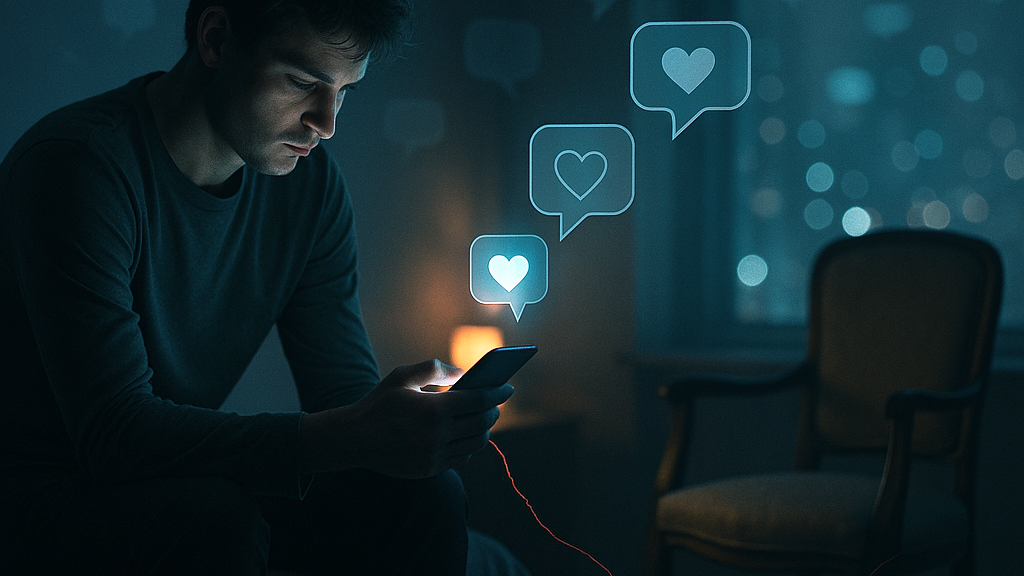
Be honest—when did you last let a person see you?
Not a DM. Not a tidy paragraph drafted by a model. I mean the messy kind: your voice catching, the dumb joke you had to explain twice, the silence where you weren’t sure what came next, and they stayed anyway.
Lately, many of us have been skipping that part. We talk all day without ever meeting a human. We confess to chatbots at 2 a.m. We ask a system how to word an apology we should stumble through ourselves. Even at work, we’ve trained our reflex: something breaks—prompt it. Ask a boss, and they say, “Did you ChatGPT it?” We don’t turn our chair and ask a colleague to think with us. We paste, we run, we move on.
Here’s the quiet truth beneath all of it: we’re getting our emotional well-being from an object that has no emotion. That’s not neutral; it rewires you. The U.S. Surgeon General has already warned that weak social connection carries a health risk comparable to smoking up to 15 cigarettes a day, and it’s linked to higher rates of heart disease, stroke, depression, anxiety, dementia, and premature death. That’s not “vibes”—that’s epidemiology.
You can see the drift in our habits. A decade ago, more Americans spent part of a typical day socializing; now fewer do, and for less time. The government’s time-use data puts it plainly: 38% of people socialized on an average day in 2014 versus 30% in 2024, and those moments got shorter—43 minutes then, 35 now. That’s the oxygen of ordinary connection, thinning out in slow motion.
And in the quiet that follows, AI is filling the space. Not just as a tool—as a stand-in. On phones alone, generative-AI apps nearly hit 1.7 billion downloads with almost $1.9 billion in consumer spend in just the first half of 2025. That isn’t experimentation; that’s adoption. Even the weekend patterns are shifting to look less like “work software” and more like a general companion you reach for anytime.
Ask people how they feel about that trade and the answer’s consistent: Americans are more concerned than excited about AI’s spread, and far larger shares say it will erode (not improve) our ability to think creatively and form meaningful relationships. In Pew’s latest work, loss of human connection shows up as a top worry. We can feel what we’re losing, even when the tools are helpful.
This is the harm we keep underestimating: we’re feeding a human need—comfort, counsel, company—to something that cannot feel. A machine can produce the shape of tenderness—soft words, perfect pacing, patient listening—but it does not care if you stay. It cannot want you. And if you live on that long enough, you forget the weight and warmth of a real response. You stop practicing the muscles that make connection possible: being misunderstood and trying again, hearing “no” without leaving, saying “I’m sorry,” and earning a second chance.
You can feel it in the micro-choices. Bad day? The bot listens. No risk, no judgment. A disagreement at home? Ask the model to craft the perfect sentence instead of sitting on the edge of the bed and getting it wrong first. Scared to tell a friend the truth? Type it into a box that nods and never argues. Each time, you pick certainty over closeness, polish over presence. It feels like progress. It’s isolation with good manners.
Work is teaching the same habit. Whole systems are being maintained by prompts now. DHCP is acting strange; DNS throws shadows; payroll’s auth loop returns. We paste, we run, we get the green check. It “works,” but nothing human moves. No one says, “Walk me through what happened,” or “Let’s go look together.” The person who actually knows the system—the lived quirks, the ugly dependencies—never sees it. The ticket returns next week because we fixed a part without sharing the understanding. Skills don’t just fail to grow; they atrophy. And yes, that’s precisely the drift people told Pew they fear: AI weakening human abilities and connections while we feel like we’re moving faster.
Hiring shows the rest of the picture. Your first “conversation” with a company might be with an agent who screens your words, your pauses, and your face. Regulators noticed—New York City’s Local Law 144 forces bias audits and public disclosures for automated hiring tools, treating them as consequential enough to audit before they screen you. The EEOC has reminded employers that if an AI tool creates an adverse impact, it’s still a Title VII problem—vendors don’t shield you. And in the wild, results are mixed: one large field experiment (about 70,000 interviews) reported higher offers and short-term retention after AI-led interviews, while other research has flagged accent transcription errors up to 22% for some non-native speakers. Faster funnels on paper; colder starts in practice—especially if the first real human moment with your future team happens after the offer.
That’s the quiet disaster: not cruelty, not scandal—absence. No one to say “wait, tell me more.” No one to notice your voice crack and decide to stay on the line. No one to catch the hunch that keeps minor problems small. We’re surrounded by replies and starving for responses.
And here’s the part that sneaks up on you: the longer you go without real contact, the harder it gets to reach for it. You forget the rhythm. You forget how to be bored together, to argue and come back, to ask for help before you’re in a hole. You start mistaking the feeling of being managed by systems for the feeling of being held by people.
I’m not anti-tool. I’m anti-substitute. Use AI to find the words—then say them to a person. Use it to outline a fix—then pull a human in and learn the system together. If a model saves you ten minutes, spend those minutes re-entering the relationship you were about to skip.
Call instead of crafting. Walk over instead of “circling back.” Tell the messy truth and let it land how it lands. If you manage a team, don’t hide the person at the end of a maze of automations—put them near the beginning. Not because bots are bad at answering, but because people are the only ones good at us.
We’re not just losing conversations; we’re losing the conditions where closeness grows. And the decline will look polite the whole way down: the prompts will keep working, the charts will keep improving, and our capacity to love, argue, forgive, and belong will quietly shrink. The public-health evidence says isolation is dangerous. The time-use data says we’re socializing less. The sentiment data says we already feel the cost.
If today’s tools helped you move faster, take what they gave back and spend it where speed can’t go: with a human being. Not as a stunt. As maintenance. On your relationships. On your team. On yourself.
Because the real emergency isn’t that machines are getting better at sounding human.
It’s that we might stop remembering how to be.