
I’ll start with the part most people hide: I didn’t finish this.
The spare box is still on my bench. After about a dozen wipes, it’s closer to the trash than the wall.
If there isn’t a project in motion—not a task list, a build—my head starts to ring. I don’t unwind; I scan. I design. I imagine. Then I try to make the thing I can already see. It isn't a hobby; it’s a need.
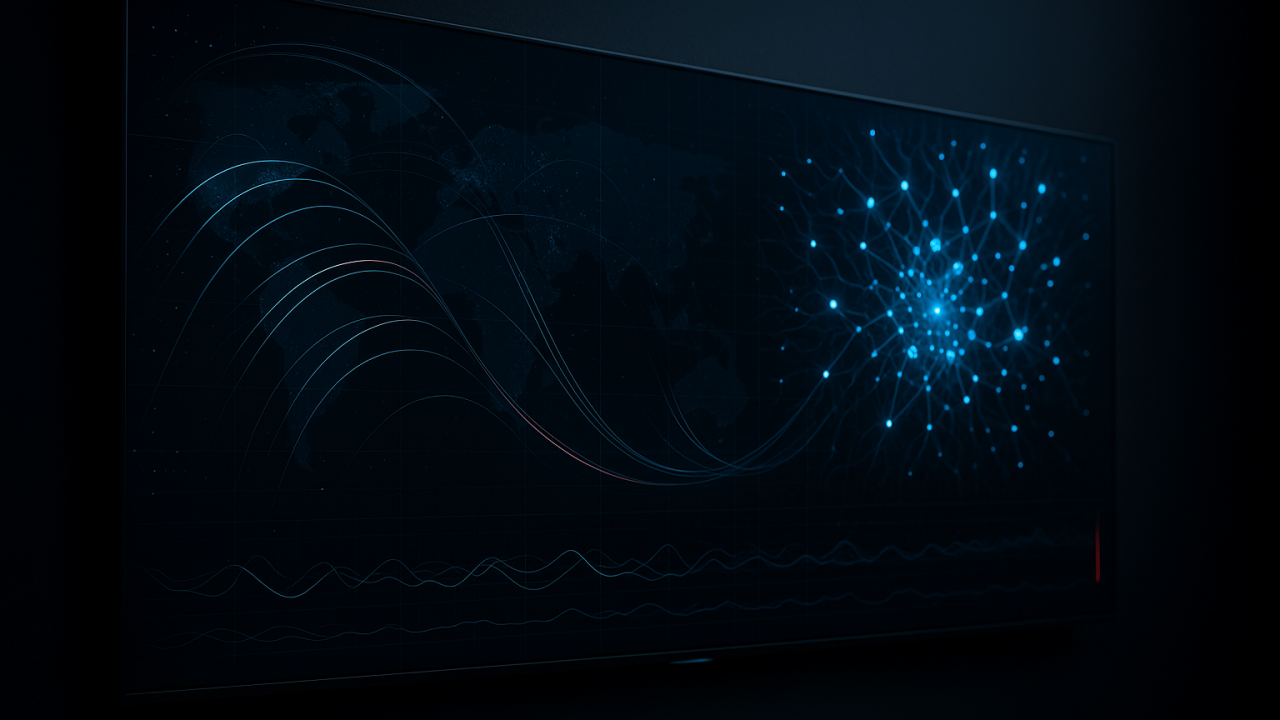
For three weeks I tried to turn that need into a wall-mounted cyber artwork that pulls live internet data—threat intel, in-the-wild chatter, current events—so it feels like a living instrument. I also chased a sibling concept: an AI with open web access where you can literally watch neurons fire as it learns. No fake feeds. No canned demos. Only live.
Every time reality missed the mental screenshot, my body said so first: neck heat, heart rate up, tunnel vision. That’s my firmware—the Finish-or-Wipe loop. “Good enough” doesn’t register as progress; it registers as wrong. Either I land it, or I pave it back to zero. Mostly, I paved.
No tidy lesson. Just the truth of what I tried and why a dead workstation is still sitting here.
The Vision: Why the Two-Degree Miss is Total Failure
I didn’t want a “pretty dashboard.” I wanted a piece—something you could hang in a SOC or a gallery and it would belong there. Three non-negotiables:
Be Useful. Reveal pressure, surface signal, expose pattern—tell a truth in the data.
Look Cinematic. Crisp, coherent, a calm cadence that makes chaos legible.
Impress Practitioners. A security pro should stare ten seconds and say, “That’s real—how’d you do it?”
Break one, go to zero. That’s the loop.
The Attempts (and the Unforgivable Lag)
Every failure was a near-miss, killed by a margin I couldn't accept.
Live SOC Artwork: Pull live signals and translate them into motion: arcs, pulses, pressure waves. A heartbeat on glass.
Why it died: Latency hiccups broke the illusion. One dropped frame and “alive” became “laggy.” Neck lit. Wipe.
The Learning AI Brain: Open-web AI showing an honest thinking trail (source to idea to claim).
Why it died: Render drifted out of sync with real reasoning—compute vs. fetch vs. draw. If timing isn’t perfect, the magic dies. Wipe.
The One-Screen Instrument: Fuse both: internet-fed signal + visible AI behavior + a steady cadence. One instrument. No widget farm.
Why it died: Under burst, the render lagged a half step. The composition stopped feeling inevitable. Wipe.
If you’re asking, “Why not accept 95%?”—that’s the point. Two degrees off might as well be 200 when the goal is to make the invisible look inevitable.
The Wiring: The High-Gain Control Loop
People name parts of this perfectionism, perseveration, Zeigarnik buzz—maybe maximizer. I call it a high-gain control loop.
My system hears “not resolved,” and sends the whole body to fix it.
Signals: neck heat, pulse spike, narrowed focus.
Cost: time, sleep, zero tolerance for “meh.”
Gift: precision, originality, locked flow— the same force that makes my production systems refuse to be brittle.
I haven’t aimed it. I’ve tried. It still drives me crazy. Tonight I’m closer to throwing the box out than plugging it back in.
Where it Stands
When there’s no live project, the motor turns inward and climbs the walls. The only thing that quiets the room is when the screen answers the web in the exact cadence I pictured. That hasn’t happened. Yet.
I still want the living SOC piece that shows threat pressure without a caption.
I still want the AI brain that draws its own trail, not just the answer.
I still want one screen that breathes with the internet and feels inevitable when it moves.
I don’t have them. Yet.
If you’ve fought this loop—and especially if you haven’t beaten it—drop the one moment you knew a wipe was the only honest call, or the one trick that kept you from erasing a working truth. I’ll pin a few below mine.