
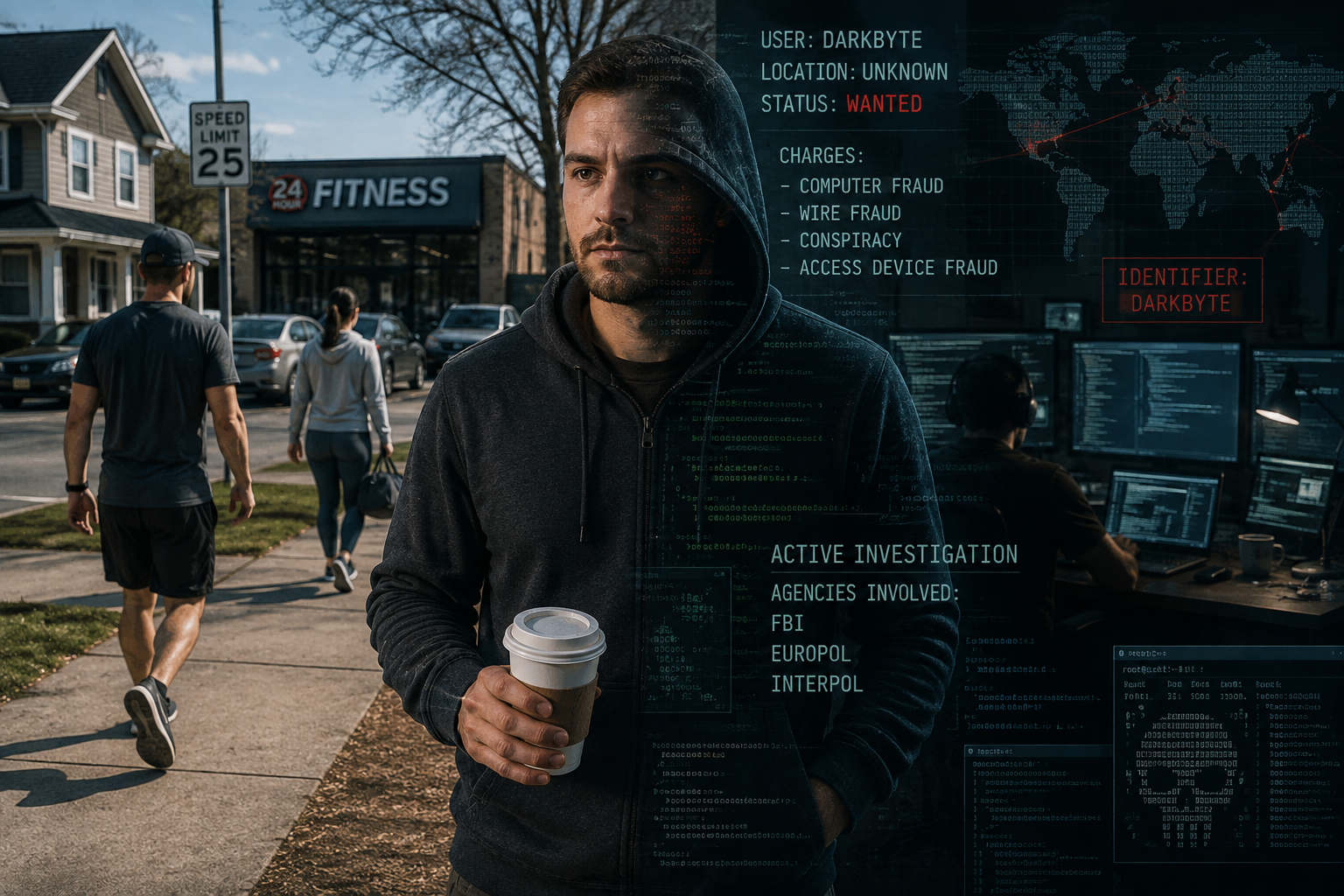
Ask anyone to describe a hacker and you get the same answer.
Dark room. Multiple monitors. Hoodie. Somewhere big enough to disappear into. New York, London, Moscow, Bucharest. Somewhere with an underground.
Now look at the actual lists.
The FBI keeps a cyber most wanted page. Europol and Interpol maintain their own. Some of those entries have names and faces. Plenty of them don’t, because the government charges people it can’t identify.
When the Justice Department unsealed the Zeus malware indictment out of Nebraska, it charged nine people in a scheme that drained millions out of business bank accounts. All nine were listed by the online nicknames they used while doing it. Three of them had nothing else. No name, no country, no photograph. A federal grand jury returned charges against a username.
It still happens. In December, DOJ named an individual operating as “Cyber_1ce_Killer” as the person directing targeting for a hacking crew that hit water utilities and a meat processing plant, and financed their access to DDoS-for-hire services. A moniker associated with at least one GRU officer. That’s as close as the announcement gets, because that’s as close as anybody has gotten.
There’s even standard language for it. Indictments routinely charge a defendant along with “co-conspirators known and unknown to the grand jury.” The system has a slot built into it for people nobody can name.
Charges against a string of characters. A manhunt with an empty name field.
So where is that person actually sitting?
Not in a warehouse loft in Kiev. He’s in a subdivision. A small town. A suburb nobody outside the county has heard of. He’s at the grocery store, sitting in traffic, picking up his kids.
And if he works in this field, and a lot of them do, he’s at your conference.
The picture is wrong, and not because it’s outdated. It was never right, because the thing it claims to describe has never had a physical form.
It was never geographic
There’s a version of this argument that says the internet made talent portable. That one’s wrong too, just less obviously.
It was never local. Not in the BBS days, not during phone phreaking, not at any point since. The scene was always distributed because the scene was always a network.
Getting genuinely good at this takes years, and almost all of those years are spent alone in front of a machine.
Reading code until the patterns start showing themselves. Breaking something, then breaking it again a different way. Sitting with a binary for a week because there’s something in it you don’t understand yet and you refuse to leave it alone. Building the lab, wrecking the lab, rebuilding it. Failing at the same problem enough times that you finally see the shape of it.
Nobody watches that happen. It doesn’t require a mentor, a lab, a degree, or a city with a scene in it. It requires obsession and a machine and an enormous amount of time nobody else is accounting for.
So the person doing it can be anywhere, and the thing that separates the ones who get truly good from everyone else has nothing to do with where they were sitting while they did it.
Nothing about it is visible
There’s no physical characteristic that separates an elite security researcher from an elite criminal.
None. Not a look, not a build, not a neighborhood, not a car, not a way of talking. The guy publishing CVEs and the guy selling access on a forum can have identical lives on the street. Same grocery store. Same traffic. Same forty minutes on the same treadmill.
The work doesn’t leave a mark on a person.
Most things people are good at don’t work that way. Athletes look like athletes. Trades show up in somebody’s hands. Even office work leaves something behind. A commute. A badge. A schedule you could watch. This leaves none of it.
So the physical world holds zero information about it.
You can’t look at somebody and rule it out. You can’t look at somebody and rule it in. There’s no tell, because there’s nothing for a tell to attach to.
They’re in the industry
This is the part nobody wants to say out loud.
The skills are the same skills. Reverse engineering, exploit development, network intrusion, malware analysis, operational security. The person who does it for a paycheck and the person who does it for money nobody reports are running the same playbook. A lot of them learned in the same places, on the same forums, from the same writeups.
So of course they work in the field. Where else would they work?
They’re doing pentests. They’re on IR teams. They’re writing detection rules. They’re presenting at conferences, sitting in the audience at conferences, drinking at the bar after conferences with people who are actively looking for them and don’t know it.
That’s not hypothetical.
In 2017, Marcus Hutchins went to DEF CON. He’d become famous a few months earlier for registering the domain that stopped WannaCry from spreading, and he spent that week in Vegas being treated like what he was, which was the guy who’d stopped the worst ransomware outbreak in years. Then he got arrested at the airport on his way home. A sealed indictment had been sitting there the whole time, from years earlier, over the Kronos banking malware.
Everybody in that building that week was in a room with a wanted man and nobody knew, including him.
That’s the shape of this. Not somebody skulking around the edges of the industry. Somebody in the middle of it, doing good work, well liked, with a case file on the other side of his life that has nothing to do with the person people are shaking hands with.
The comparison people reach for
The closest thing most people have in their heads is the serial killer who turned out to be the guy from church.
It gets reached for because of the shock. Neighbors on the news saying he seemed quiet, he was helpful, he coached the team.
The comparison holds right up until it breaks, and the break is where this gets strange.
Those people were performing. The church role, the volunteering, the barbecues, all of it was maintenance on a front. There was something to conceal and concealing it took work. When it came apart, what everybody had been looking at turned out to be a construction.
That’s not what’s happening here.
Somebody with a warrant out for his handle isn’t maintaining a cover. There’s no cover. His ordinary life is just his life. He’s not performing normal, he’s got no reason to act any different than he already does, because nothing he does at 2 a.m. shows up in the line for coffee at 9.
He doesn’t have to hide. There was never anything to see.
Stranger than deception, and a lot harder to think about.
What wanted actually looks like
Everything the public understands about being hunted comes from violent crime.
Running. Changing your appearance. Moving. Dropping the job, the routine, the people. The fugitive as somebody whose life visibly came apart because of what they did.
None of that applies here.
A handle can be charged in one country, sought in two more, written up in threat intel on three continents, and named in security briefings at companies the person has never heard of. None of it touches his week, because none of it is attached to him. It’s attached to the name he types.
His exposure lives on machines.
That’s where the case gets built, and it’s the only place it can get built, because the physical world has nothing to contribute. Nobody’s canvassing a neighborhood. They’re correlating an IP that leaked once, a payment that touched a real bank, a device that hit home wifi, a handle he reused eight years ago on a forum he forgot about, a package that had to be delivered somewhere.
Capability went global. Consequences stayed local. It just takes a long time for the second one to catch up to the first, and until it does, nothing about the person changes at all.
Two people, one body
Online, the handle matters.
It’s in forum archives, breach writeups, vendor reporting, indictments, and conversations between security teams who’ll never meet. Thousands of professionals know it. Some of them have spent months of their lives on it.
Offline he’s the guy who comes in every morning and orders the same thing.
Neither one is a disguise. They’re both true at the same time, and neither leaks into the other, because reputation in this field attaches to a string of characters instead of a face. The name that matters has no body attached. The body has no name attached.
Most people with serious capability here aren’t criminals. That should be obvious and it’s worth saying anyway. The large majority are in security, research, IR, engineering, or they’re not in the field at all and just happen to be very good at something.
The invisibility covers all of them the same.
What we actually believe
We think danger is legible.
We think it shows up in a person somehow. In how they look, where they live, what they seem like. That’s why neighbors are always shocked, why juries want a defendant to look the part, why the hoodie in the dark room became the picture in the first place.
It’s a comfortable thing to believe, because it means you’d be able to tell.
You can’t tell. There’s no version of paying closer attention that helps, no detail you’d catch if you were sharper. The information isn’t being kept from you. It doesn’t exist where you’re looking.
Somebody in your town is better at this than anybody would guess. That’s true in most towns. Whether that person is publishing research, working a help desk, running a business, or getting hunted by four agencies isn’t something the street is going to tell you.
The stereotype puts the dangerous person somewhere else. Somewhere bigger. Somewhere darker. Somewhere that looks like where a hacker is supposed to live.
There’s no place a hacker is supposed to live.
So tomorrow morning, while investigators in three countries work a case filed against a name that belongs to nobody, the person that name belongs to is going to get up, go to work, and stand in line for coffee like everybody else.
Nobody in that line is going to notice a thing.
Not because he’s good at hiding.
Because there’s nothing to see.
Sources: Zeus indictment, United States v. Penchukov, D. Neb., unsealed April 2014; nine defendants charged under online nicknames, three identified by username only. “Cyber_1ce_Killer” per Justice Department announcement, December 2025. Marcus Hutchins was arrested at Las Vegas airport in August 2017 following DEF CON, on a sealed indictment relating to the Kronos banking malware; he was later released and the case resolved without prison time. FBI Cyber Most Wanted, Europol and Interpol wanted listings are public.
Leave a Reply